Targeted protein degradation (TPD)
Targeted protein degradation (TPD) refers to the deliberate breakdown of specific proteins within cells. This process is crucial for regulating various cellular functions, maintaining protein quality, and responding to changes in the environment. The primary mechanisms involved include the ubiquitin-proteasome system (UPS), the autophagy-lysosome pathway, and proteolysis-targeting chimeras (PROTACs). In the UPS, proteins marked with ubiquitin are directed to the proteasome for degradation. The autophagy-lysosome pathway involves the sequestration of damaged proteins into autophagosomes, which fuse with lysosomes for enzymatic degradation.
PROTACs are small molecules that recruit E3 ubiquitin ligases to specific target proteins, marking them for degradation via the UPS. These mechanisms collectively ensure the timely removal of malfunctioning or superfluous proteins, thereby maintaining cellular function and health.
Degrader Design and Synthesis
Proteasomal degradation
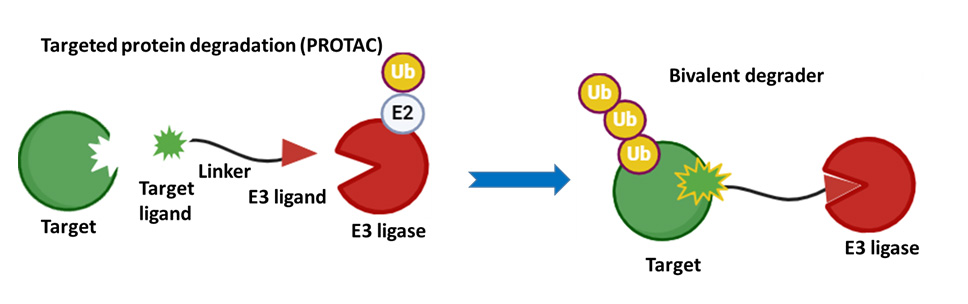
Bivalent PROTACs
Two ligands connected by a linker, bringing the target protein and E3 ligase together for degradation.
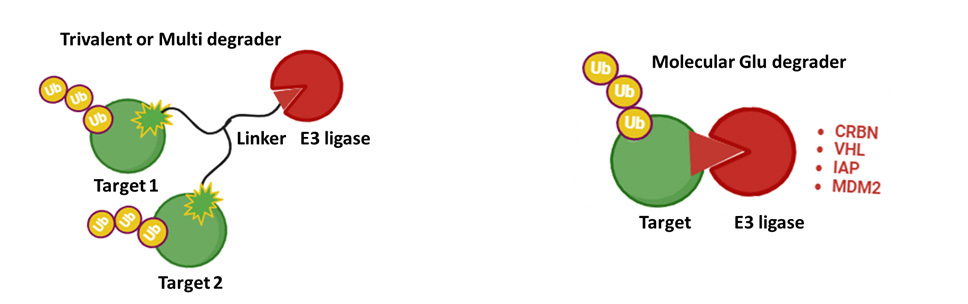
Trivalent PROTACs
Three binding elements, targeting two proteins and an E3 ligase, for complex protein degradation.
Molecular Glue
Molecular glues work by targeting a protein-protein direct interaction between the target protein and an E3 ubiquitin ligase.
Lysosome-mediated TPD degradation
The emerging lysosome-mediated TPD approaches, such as AUTAC, ATTEC, AUTOTAC, LYTAC, and MoDA-A, provide new strategies for targeted protein degradation and expend their application in human diseases.
AUTAC: Relying on autophagy, AUTAC degrades a wider range of substrates by inducing K63 polyubiquitination. This approach is particularly effective for degrading cytoplasmic target proteins that are resistant to PROTAC molecules.
AUTOTAC: Relying on the autophagy pathway, AUTOTAC degrades a wider range of substrates by inducing K63 polyubiquitination. This method is especially suitable for degrading cytoplasmic target proteins that are resistant to PROTAC molecules.
ATTEC: Unlike PROTACs and AUTACs, ATTEC molecules do not rely on ubiquitination. Instead, they utilize the LC3 protein, representing a novel strategy for protein degradation through the macroautophagy/autophagy pathway.
LYTAC: LYTAC targets proteins for degradation through lysosomal pathways. Unlike PROTAC, LYTAC can target extracellular and membrane-associated proteins by using conjugates that bind both a cell-surface lysosome-shuttling receptor and the extracellular domain, allowing for a broader range of protein types to be targeted.
MoDA-A: MoDA-Ais a class of degraders designed to target and degrade specific autophagy adaptors. These adaptors are proteins that facilitate the linking of cellular cargo to the autophagy machinery. By promoting the degradation of these adaptors, MoDA-A can modulate the autophagy process and influence the degradation of various substrates that are processed through autophagy.
Our Services for TPD Technology Development
Targeted protein degradation can be achieved with small molecule protein degraders such as PROTACs and molecular glue molecules for proteasomal degradation, as well as AUTAC, ATTEC, AUTOTAC, LYTAC, and MoDA-A for lysosomal degradation. Novoridge is a leading provider of contract research services specializing in Degrader Design and Synthesis. Our competitive pricing and extensive expertise have made us a trusted partner for many customers. Contact usto know more about how Novoridge can support your project and help you achieve your goals efficiently and cost-effectively.
- Degrader Design and Synthesis of TPD molecules (Proteasomal degradation; Bivalent, Trivalent PROTACs, Molecular Glue, as well as Lysosomal degradation; AUTAC, ATTEC, AUTOTAC, LYTAC, and MoDE-A).
- TPD molecules design and screening
- Screening compounds with high affinity for target protein using virtual screening techniques on compound databases.
- Design and synthesis of E3 ligase ligand and Ligand-linker conjugates
- Chemical structure modifications to enhance the properties of drug molecules
- Chemical services encompassing all stages of TPD molecule design, synthesis, and lead optimization
Why is Novoridge the preferred choice for TPD services?
- Dedicated to developing innovative TPD degradation technology, specifically proteasomal and autophagy lysosomal degradation pathways
- Our expertise and dedicated team of experienced scientists
- Data analysis and detailed reports with results and discussion
- Highly reliable, and reproducible result
- Flexible and client-centric approach
- Efficient project management, rapid turn-around time, and competitive price